Psychiatric
Poster
Spontaneous sentence elaboration as a projective vocal probe for sub-clinical distress: A comparison with autobiographical recall tasks
Felix Menne, Felix Dörr, Julia Schräder, Julia Koch, Nick Worm, Linda C. M. Wilkin-Krug, Isabel Neumann, Johannes Tröger, Lisa Wagels, Katja Bertsch, Alexandra König
*Presented at ECNP 2026
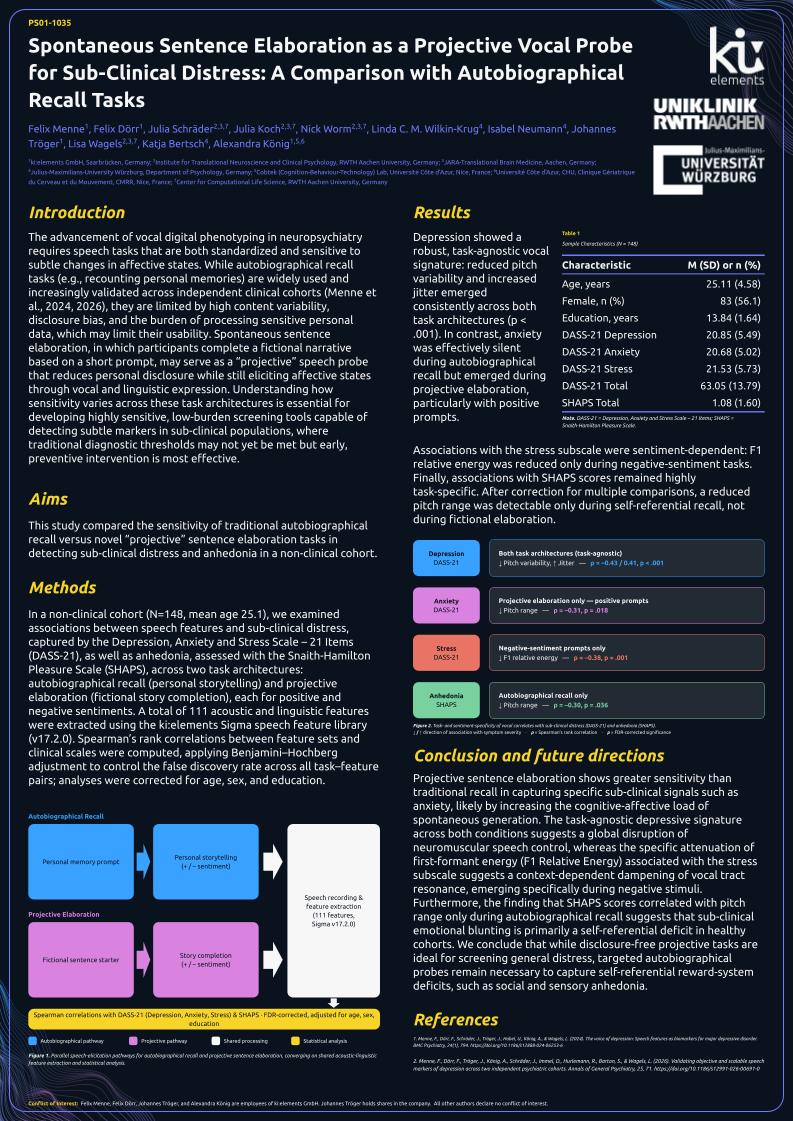
Background: The advancement of vocal digital phenotyping in neuropsychiatry requires speech tasks that are both standardized and sensitive to subtle changes in affective states. While autobiographical recall tasks (e.g., recounting personal memories) are widely used, they are limited by high content variability, disclosure bias, and the burden of processing sensitive personal data, which may limit their usability. Spontaneous sentence elaboration, in which participants complete a fictional narrative based on a short prompt, may serve as a "projective" digital speech-probe that reduces personal disclosure while still eliciting affective states through vocal and linguistic expression. Understanding how sensitivity varies across these task architectures is essential for developing highly sensitive, low-burden screening tools capable of detecting subtle markers in sub-clinical populations, where traditional diagnostic thresholds may not yet be met but early preventive intervention is most effective.
Aims: This study compared the sensitivity of traditional autobiographical recall versus novel "projective" sentence elaboration tasks in detecting sub-clinical distress and anhedonia.
Methods: In a non-clinical cohort (N=148, mean age 25.1), we examined associations between speech features and sub-clinical distress captured by the Depression, Anxiety and Stress Scale - 21 Items (DASS-21) as well as anhedonia assessed with the Snaith-Hamilton Pleasure Scale (SHAPS) across two distinct task architectures: autobiographical recall (personal storytelling) and projective elaboration (fictional story completion) for both positive and negative sentiments. A total of 111 acoustic and linguistic features were extracted using the ki:elements Sigma speech feature library (v17.2.0). To ensure the robustness of the digital speech measures for sub-clinical distress, we computed Spearman’s rank correlations between feature sets and clinical scales, applying Benjamini-Hochberg adjustment to control the false discovery rate across all task-feature pairs. Analyses were corrected for age, sex, and education.
Results: Scores on the DASS-21 depression subscale exhibited a robust, task-agnostic vocal signature, consistently associated across both speech prompt architectures with reduced pitch variability (⍴ = -0.43) and increased vocal instability (jitter: ⍴ = 0.41, p < 0.001). In contrast, DASS-21 anxiety subscale scores were effectively "silent" during autobiographical recall but emerged during projective elaboration, particularly with positive prompts (pitch range: ⍴ = -0.31, p = 0.018). Notably, associations with the DASS-21 stress subscale were sentiment-dependent; the F1 Relative Energy feature only showed a significant correlation during negative tasks (⍴ = -0.38, p = 0.001). Finally, associations with SHAPS scores remained highly task-specific; after correction for multiple comparison, a reduced pitch range was only detectable during self-referential recall (⍴ = -0.30, p = 0.036), but not during fictional elaboration.
Conclusion: Our findings demonstrate that projective sentence elaboration shows greater sensitivity to traditional recall in capturing specific sub-clinical signals, such as anxiety, likely by increasing the cognitive-affective load of spontaneous generation. While our findings in the depressive subscale across both task conditions suggest a global disruption of neuromuscular speech control, the specific attenuation of first-formant energy (F1 Relative Energy) associated with the DASS-21 stress subscale suggests a context-dependent dampening of vocal tract resonance, emerging specifically during negative stimuli. Furthermore, the finding that SHAPS scores only correlated with Pitch Range during autobiographical recall suggests that sub-clinical emotional blunting is primarily a self-referential deficit in healthy cohorts. We conclude that while "disclosure-free" projective tasks are ideal for screening general distress, targeted autobiographical probes remain necessary to capture self-referential reward-system deficits, such as social and sensory anhedonia.
" transform="translate(1 3)" width="19px"/><path d="M 0 0 L 19 0" fill="transparent" height="1px" id="BpzY28YkB" stroke-dasharray="0" stroke-linecap="round" stroke-linejoin="round" stroke-width="2" stroke="rgba(22, 30, 40, 0.9)" transform="translate(1 8.72)" width="19px"/><path d="M 0 0 L 19 0" fill="transparent" height="1px" id="IBoyu11e2" stroke-dasharray="0" stroke-linecap="round" stroke-linejoin="round" stroke-width="2" stroke="rgba(22, 30, 40, 0.9)" transform="translate(1 14)" width="19px"/></svg>)