Psychiatric
Poster
Hearing Anhedonia: Quantifying Vocal Digital Phenotypes Across Psychiatric Disorders in the Bridge2AI Dataset
Felix Menne, Felix Dörr, Nicklas Linz, Johannes Tröger, Alexandra König
*Presented at ECNP 2026
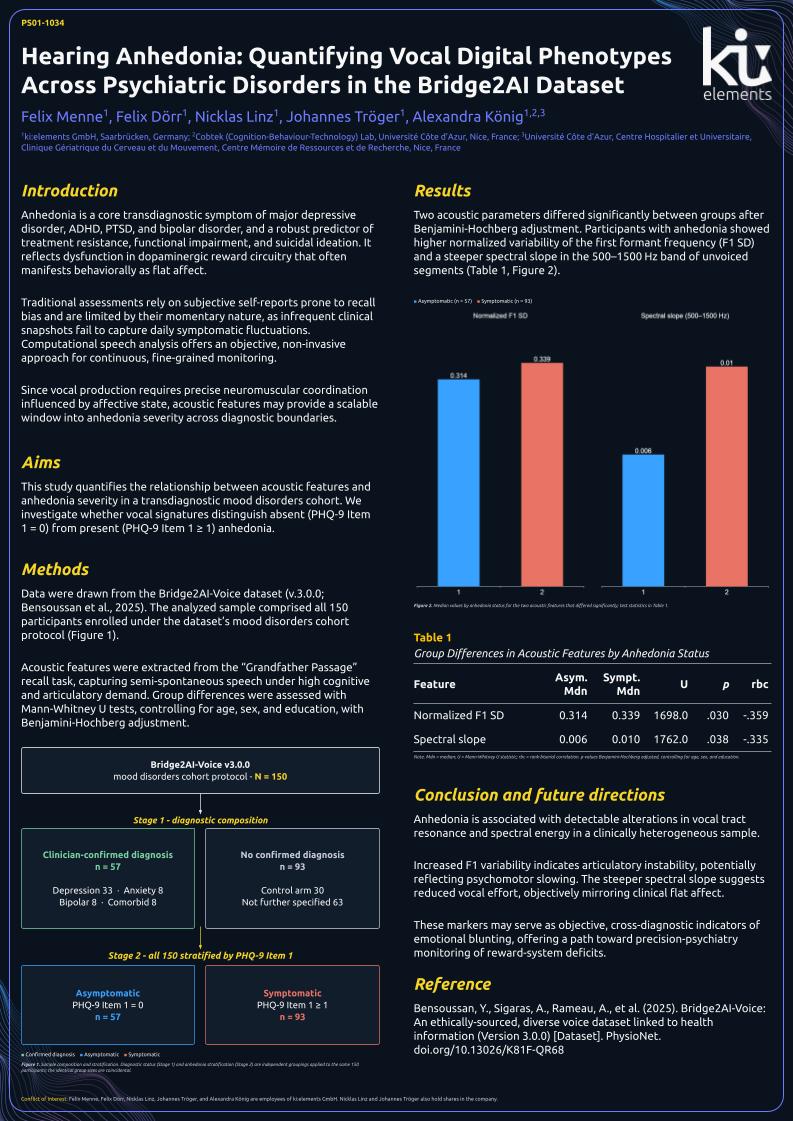
Background: Anhedonia is a core transdiagnostic symptom present in major depressive disorder, ADHD, PTSD, and bipolar disorder. It is a robust predictor of treatment resistance, functional impairment, and suicidal ideation. Anhedonia reflects underlying dysfunction in dopaminergic reward circuitry, which often manifests behaviorally as flat affect. While traditional assessments rely on subjective self-reports prone to recall bias, they are further limited by their momentary nature, as infrequent clinical snapshots often fail to capture daily symptomatic fluctuations. Computational speech analysis offers an objective, non-invasive approach for the continuous and fine-grained monitoring of symptomatic fluctuations.
Since vocal production requires precise neuromuscular coordination influenced by affective states, acoustic features may provide a scalable window into anhedonia severity across diagnostic boundaries, helping identify patients at high risk for poor outcomes regardless of their primary diagnosis.
Aims: This study aims to quantify the relationship between acoustic features and anhedonia severity in a transdiagnostic mood disorders cohort. We specifically investigate whether vocal signatures can distinguish between absent (PHQ-9 Item 1: 0) and present (PHQ-9 Item 1: ≥1) anhedonia to validate their utility for clinical monitoring.
Methods: Data were extracted from the Bridge2AI Voice dataset (v.3.0.0) (Bensoussan et al., 2025). The analyzed sample comprised all 150 participants enrolled under the dataset's mood disorders cohort protocol. Of these, 57 had a clinician-confirmed diagnosis of anxiety, depression, and/or bipolar disorder, including comorbid presentations, while the remainder comprised the cohort's control arm and participants without a specific confirmed psychiatric diagnosis on record. Anhedonia was operationalized via PHQ-9 Item 1, with participants stratified into asymptomatic (Score=0, n=57) and symptomatic (Score greater than 0, n=93) groups. Acoustic features were extracted from the “Grandfather Passage” recall task, capturing semi-spontaneous speech under high cognitive and articulatory demand. Group differences were assessed using Mann-Whitney U tests while controlling for age, sex and education with Benjamini-Hochberg adjustment, results are reported as medians (Mdn) and rank-biserial correlation (rbc) effect sizes.
Results: Significant group differences were identified in two parameters after adjustment. Participants with anhedonia exhibited a significantly higher normalized standard deviation of the first formant frequency (F1) (Mdn=0.339) compared to the asymptomatic group (Mdn=0.314; U=1698.0, p=0.030, rbc=-0.359). Additionally, the spectral slope (500 to 1500 Hz) in unvoiced segments was significantly steeper in the anhedonia group (Mdn=0.010) than in the asymptomatic group (Mdn=0.006; U=1762.0, p=0.038, rbc=-0.335).
Conclusion: These results demonstrate that anhedonia is associated with detectable alterations in vocal tract resonance and spectral energy that persist even in a clinically heterogeneous sample across psychiatric diagnoses. The increased F1 variability indicates articulatory instability, potentially reflecting the psychomotor slowing typical of reward-system dysfunction. Similarly, the steeper spectral slope suggests a thinning of vocal timbre and reduced vocal effort, objectively mirroring clinical flat affect. Crucially, these markers were identified across a heterogeneous cohort, suggesting they serve as objective, cross-diagnostic indicators of emotional blunting. By bypassing the bias of infrequent, momentary clinical assessments and the limitations of diagnostic silos, vocal phenotypes provide a potential path toward a precision psychiatry approach for monitoring reward-system deficits.
" transform="translate(1 3)" width="19px"/><path d="M 0 0 L 19 0" fill="transparent" height="1px" id="BpzY28YkB" stroke-dasharray="0" stroke-linecap="round" stroke-linejoin="round" stroke-width="2" stroke="rgba(22, 30, 40, 0.9)" transform="translate(1 8.72)" width="19px"/><path d="M 0 0 L 19 0" fill="transparent" height="1px" id="IBoyu11e2" stroke-dasharray="0" stroke-linecap="round" stroke-linejoin="round" stroke-width="2" stroke="rgba(22, 30, 40, 0.9)" transform="translate(1 14)" width="19px"/></svg>)