Anahita Kyani; Srinivasan Vairavan; Federico Parisi; Dzmitry Kaliukhovich; Cathy Bleys; Macarena Garcia Valdecasas Colell; Sara Gale; Bahador Marzban; Nicklas Linz; Johannes Tröger; David Henley; Tricia Thornton-Wells; Bryan Hansen, and Lennert Steukers
*Presented at CTAD 2025
Background
RETAIN is a phase 2b study evaluating the efficacy, safety, and immunogenicity of a phosphorylated tau-targeted active immunotherapy, developed in partnership with AC Immune SA (Lausanne, Switzerland), in individuals with preclinical Alzheimer’s disease (AD). To identify individuals with preclinical AD, the study incorporates an innovative prescreening strategy that includes a speech-based digital cognitive assessment developed by ki:elements GmbH along with a blood-based p217+tau assay developed by Johnson & Johnson available on the Quanterix platform (LucentAD)1. The speech based digital cognitive assessment was included to collect data to inform whether it could serve as a low-burden and efficient tool for identifying individuals who are likely in the preclinical stage of disease and support blood-based biomarker testing. Patient identification through this dual approach is aimed to reduce screen failure rates, minimize trial costs, and improve recruitment efficiency.
Rationale
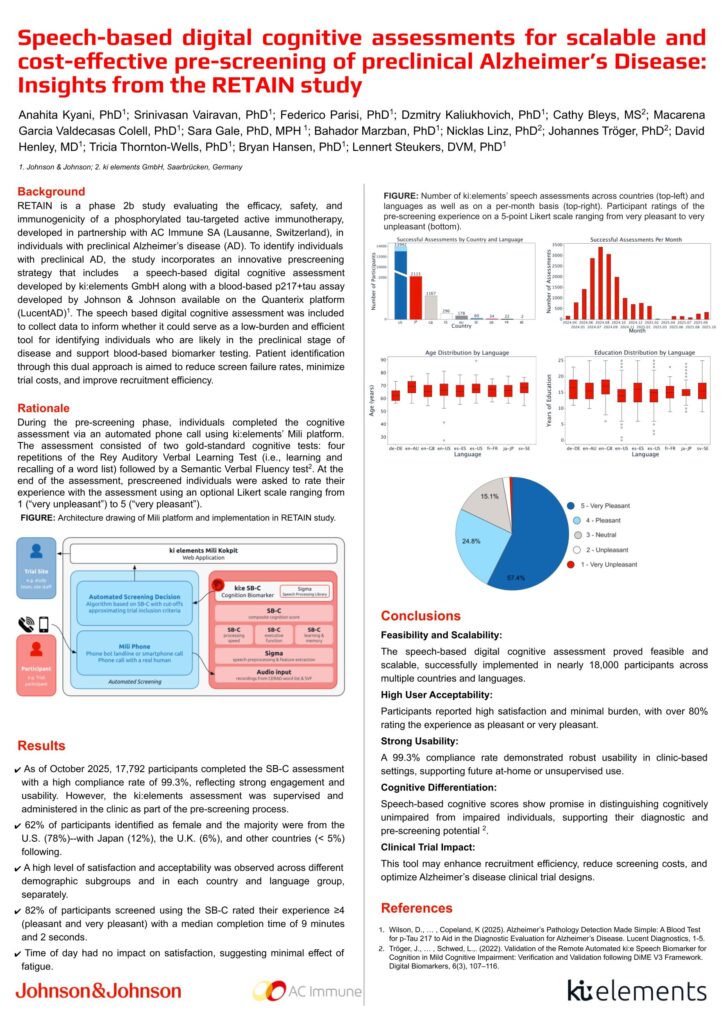
During the pre-screening phase, individuals completed the cognitive assessment via an automated phone call using ki:elements’ Mili platform. The assessment consisted of two gold-standard cognitive tests: four repetitions of the Rey Auditory Verbal Learning Test (i.e., learning and recalling of a word list) followed by a Semantic Verbal Fluency test2. At the end of the assessment, prescreened individuals were asked to rate their experience with the assessment using an optional Likert scale ranging from 1 (“very unpleasant”) to 5 (“very pleasant”).
Results
- As of October 2025, 17,792 participants completed the SB-C assessment with a high compliance rate of 99.3%, reflecting strong engagement and usability. However, the ki:elements assessment was supervised and administered in the clinic as part of the pre-screening process.
- 62% of participants identified as female and the majority were from the U.S. (78%)–with Japan (12%), the U.K. (6%), and other countries (< 5%) following.
- A high level of satisfaction and acceptability was observed across different demographic subgroups and in each country and language group, separately.
- 82% of participants screened using the SB-C rated their experience ≥4 (pleasant and very pleasant) with a median completion time of 9 minutes and 2 seconds.
- Time of day had no impact on satisfaction, suggesting minimal effect of fatigue.
Conclusions
Feasibility and Scalability:
The speech-based digital cognitive assessment proved feasible and scalable, successfully implemented in nearly 18,000 participants across multiple countries and languages.
High User Acceptability:
Participants reported high satisfaction and minimal burden, with over 80% rating the experience as pleasant or very pleasant.
Strong Usability:
A 99.3% compliance rate demonstrated robust usability in clinic-based settings, supporting future at-home or unsupervised use.
Cognitive Differentiation:
Speech-based cognitive scores show promise in distinguishing cognitively unimpaired from impaired individuals, supporting their diagnostic and pre-screening potential 2.
Clinical Trial Impact:
This tool may enhance recruitment efficiency, reduce screening costs, and optimize Alzheimer’s disease clinical trial designs.