Elisa Malick, Johannes Tröger, Stefanie Köhler, Alexandra König, Anika Wuestefeld, Erik Stomrud, Pontus Tideman, Oskar Hansson, Sebastian Palmqvist, Stefan Teipel, and Nicklas Linz
*Presented at CTAD 2025
Background: Remote digital cognitive assessments allow more frequent monitoring and may detect changes earlier than traditional in-clinic evaluations. The ki:elements Speech Biomarker for Cognition (SB-C) is a low-burden, remote, and cost-efficient tool for tracking cognitive changes across the Alzheimer’s disease (AD) spectrum. It combines an automated landline telephone protocol with automated analysis of two established speech-based tasks: the Rey Auditory Verbal Learning Test (RAVLT) and Semantic Verbal Fluency (SVF).
In this study, we investigated whether remote longitudinal administration of the SB-C over landline telephone calls could track cognitive changes over time in a multi-site Swedish-German memory clinic population.
Methods: We examined whether longitudinal SB-C assessments track cognitive change over time in two PROSPECT-AD memory clinic cohorts: the Swedish BioFINDER-Primary Care (N=103, mean age=76.6 ± 6.4) and German DESCRIBE-AD registry (N=177, mean age=72.9 ± 7.4). Participants completed automated telephone-based assessments at baseline (t0) and 3, 6, and 12 months (t3, t6, t12). SB-C scores were derived from RAVLT and SVF speech recordings using ki:elements’ proprietary pipeline with automatic speech recognition and feature extraction. The resulting global cognition z-scores were corrected for age and education.
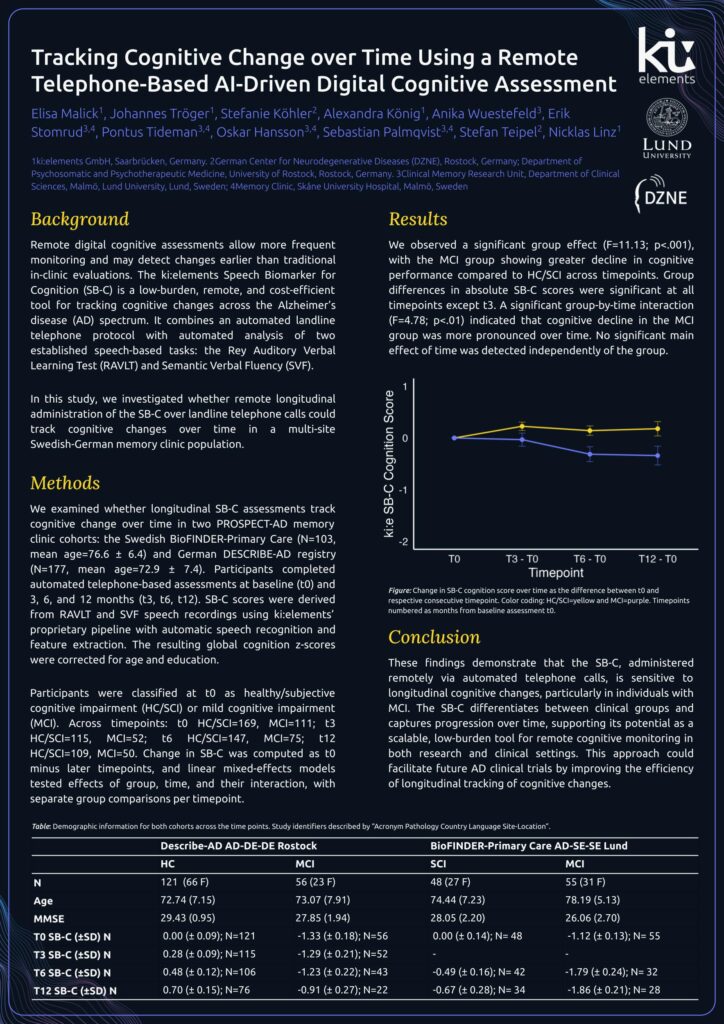
Participants were classified at t0 as healthy/subjective cognitive impairment (HC/SCI) or mild cognitive impairment (MCI). Across timepoints: t0 HC/SCI=169, MCI=111; t3 HC/SCI=115, MCI=52; t6 HC/SCI=147, MCI=75; t12 HC/SCI=109, MCI=50. Change in SB-C was computed as t0 minus later timepoints, and linear mixed-effects models tested effects of group, time, and their interaction, with separate group comparisons per timepoint.
Results: We observed a significant group effect (F=11.13; p<.001), with the MCI group showing greater decline in cognitive performance compared to HC/SCI across timepoints. Group differences in absolute SB-C scores were significant at all timepoints except t3. A significant group-by-time interaction (F=4.78; p<.01) indicated that cognitive decline in the MCI group was more pronounced over time. No significant main effect of time was detected independently of the group.
Conclusion: These findings demonstrate that the SB-C, administered remotely via automated telephone calls, is sensitive to longitudinal cognitive changes, particularly in individuals with MCI. The SB-C differentiates between clinical groups and captures progression over time, supporting its potential as a scalable, low-burden tool for remote cognitive monitoring in both research and clinical settings. This approach could facilitate future AD clinical trials by improving the efficiency of longitudinal tracking of cognitive changes.