Felix Menne, Felix Dörr, Johannes Tröger, Alexandra König, Julia Schräder, Diana Immel, Simon Barton, René Hurlemann, Lisa Wagels
Presented at ECNP 2025
Background:
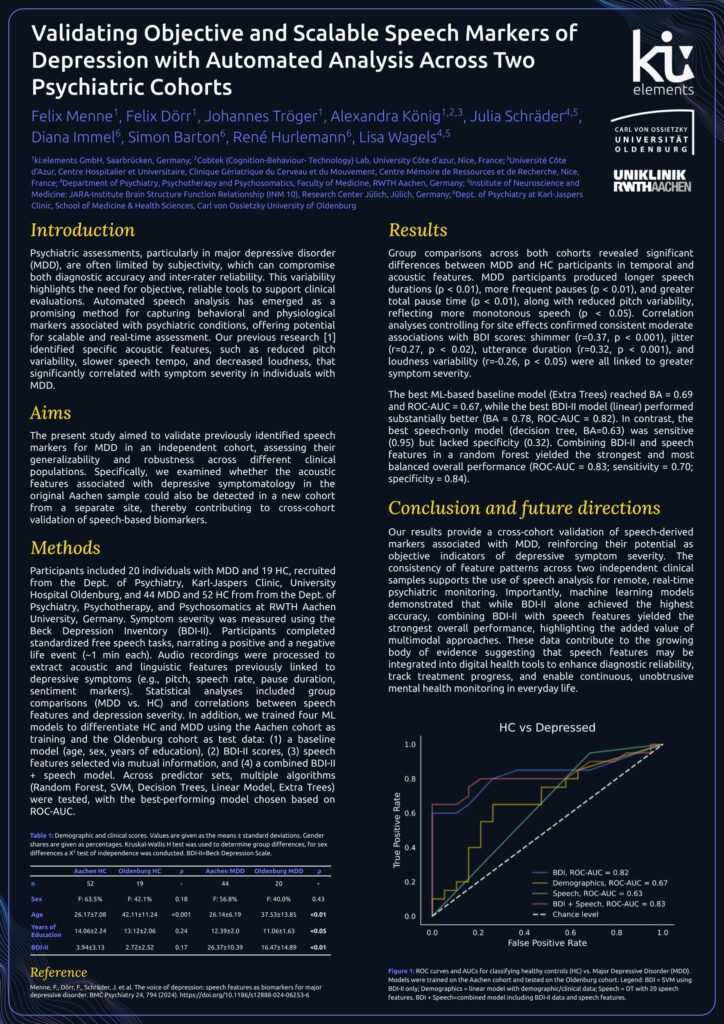
Psychiatric assessments, particularly in major depressive disorder (MDD), are often limited by subjectivity, which can compromise both diagnostic accuracy and inter-rater reliability. This variability highlights the need for objective, reliable tools to support clinical evaluations. Automated speech analysis has emerged as a promising method for capturing behavioral and physiological markers associated with psychiatric conditions, offering potential for scalable and real-time assessment. Our previous research [1] identified specific acoustic features—such as reduced pitch variability, slower speech tempo, and decreased loudness—that significantly correlated with symptom severity in individuals with MDD. These findings were based on a cohort of 44 MDD patients and 52 healthy controls (HC) from the RWTH University Hospital Aachen, Germany.
Aims:
The present study aimed to validate previously identified speech markers for MDD in an independent cohort, assessing their generalizability and robustness across different clinical populations. Specifically, we examined whether the acoustic features associated with depressive symptomatology in the original Aachen sample could also be detected in a new cohort from a separate site, thereby contributing to cross-cohort validation of speech-based biomarkers.
Methods:
Participants included 22 individuals diagnosed with MDD and 22 HC, recruited from the Dept. of Psychiatry, Karl-Jaspers Clinic, University Hospital Oldenburg, Germany. Diagnoses were established using DSM-V criteria, and symptom severity was measured using the Beck Depression Inventory (BDI). Participants completed standardized free speech tasks in-clinic. Participants were asked to narrate a positive and a negative event from their life within approximately one minute. Audio recordings were processed to extract a consistent set of acoustic and linguistic features previously linked to depressive symptoms, such as pitch, speech rate, pause duration, and sentiment markers.
Results:
Group comparisons across both cohorts revealed significant differences between MDD and HC participants in several categories, such as temporal and acoustic features. Across both sites, MDD participants showed longer overall speech durations (p < 0.01), more frequent pauses (p < 0.01), and greater total pause time (p < 0.01). Furthermore, in both cohorts, MDD participants showed lower pitch variability, indicating more monotonous speech (p < 0.05).
Correlation analyses, which controlled for cohort sites to account for potential differences between locations, further highlighted features associated with symptom severity on the BDI. These associations were consistent across both cohorts. Measures of vocal instability, such as shimmer (p < 0.001) and jitter (p < 0.02), were significantly correlated with higher depression scores. Additionally, overall utterance duration (p < 0.001) and loudness variability (p < 0.05) were positively associated with depression severity.
Conclusion:
Our results provide a cross-cohort validation of speech-derived markers associated with MDD, reinforcing their potential as objective indicators of depressive symptom severity. The consistency of feature patterns across two independent clinical samples supports the use of speech analysis for remote, real-time psychiatric monitoring. These data contribute to the growing body of evidence suggesting that speech features may be integrated into digital health tools to enhance diagnostic reliability, track treatment progress, and enable continuous, unobtrusive mental health monitoring in everyday life.