Alexandra König1, Jefimija Cubrilo2, Louisa Schwed1, Elisa Mallick1, Johannes Tröger1, Jelena Wehrli2, Miriam Rabl2, Julius Popp2,3
*Poster presented at AAIC 2026
Introduction: Characterizing the phenotypic heterogeneity of neurodegenerative disorders requires tools capturing both cognitive decline and neuropsychiatric symptoms. While digital biomarkers like the Speech Biomarker for Cognition (SB-C) track objective impairment, they may not fully reflect affective and behavioral shifts associated with early neurodegeneration. As an scalable alternative to traditional assessment, narrative speech potentially offers a distinct window into these changes. This study aims to validate the SB-C for classifying cognitive impairment and investigate whether speech-derived indices provide incremental information regarding Mild Behavioral Impairment (MBI) symptoms.
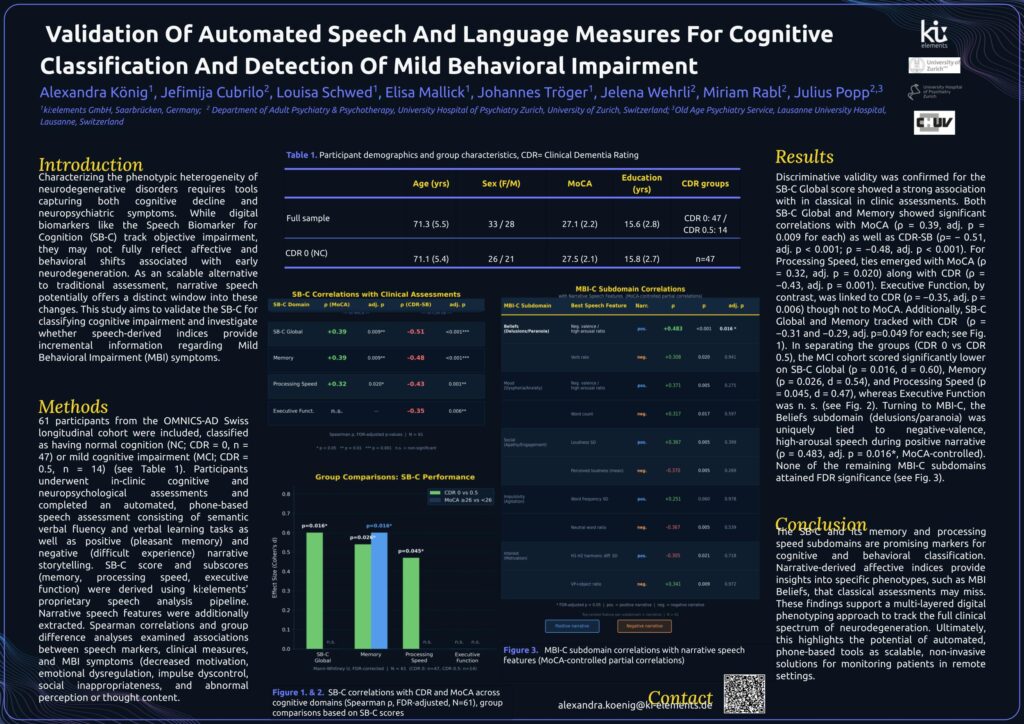
Methods: 61 participants from the OMNICS-AD Swiss longitudinal cohort were included, classified as having normal cognition (NC; CDR = 0, n = 47) or mild cognitive impairment (MCI; CDR = 0.5, n = 14) (see Table 1). Participants underwent in-clinic cognitive and neuropsychological assessments and completed an automated, phone-based speech assessment consisting of semantic verbal fluency and verbal learning tasks as well as positive (pleasant memory) and negative (difficult experience) narrative storytelling. SB-C score and subscores (memory, processing speed, executive function) were derived using ki:elements’ proprietary speech analysis pipeline. Narrative speech features were additionally extracted. Spearman correlations and group difference analyses examined associations between speech markers, clinical measures, and MBI symptoms (decreased motivation, emotional dysregulation, impulse dyscontrol, social inappropriateness, and abnormal perception or thought content.
Results: Discriminative validity was confirmed for the SB-C Global score showed a strong association with in classical in clinic assessments. Both SB-C Global and Memory showed significant correlations with MoCA (ρ = 0.39, adj. p = 0.009 for each) as well as CDR-SB (ρ= − 0.51, adj. p < 0.001; ρ = −0.48, adj. p < 0.001). For Processing Speed, ties emerged with MoCA (ρ = 0.32, adj. p = 0.020) along with CDR (ρ = −0.43, adj. p = 0.001). Executive Function, by contrast, was linked to CDR (ρ = −0.35, adj. p = 0.006) though not to MoCA. Additionally, SB-C Global and Memory tracked with CDR (ρ = −0.31 and −0.29, adj. p=0.049 for each; see Fig. 1). In separating the groups (CDR 0 vs CDR 0.5), the MCI cohort scored significantly lower on SB-C Global (p = 0.016, d = 0.60), Memory (p = 0.026, d = 0.54), and Processing Speed (p = 0.045, d = 0.47), whereas Executive Function was n. s. (see Fig. 2). Turning to MBI-C, the Beliefs subdomain (delusions/paranoia) was uniquely tied to negative-valence, high-arousal speech during positive narrative (ρ = 0.483, adj. p = 0.016*, MoCA-controlled). None of the remaining MBI-C subdomains attained FDR significance (see Fig. 3).
Conclusion: The SB-C and its memory and processing speed subdomains are promising markers for cognitive and behavioral classification. Narrative-derived affective indices provide insights into specific phenotypes, such as MBI Beliefs, that classical assessments may miss. These findings support a multi-layered digital phenotyping approach to track the full clinical spectrum of neurodegeneration. Ultimately, this highlights the potential of automated, phone-based tools as scalable, non-invasive solutions for monitoring patients in remote settings.