Clàudia Porta-Mas, Andreea Rădoi, Alexandra König, Elisa Malick, Johannes Tröger, Oriol Grau-Rivera, Gemma Salvadó, Gonzalo Sánchez-Benavides
*Poster presented at AAIC 2026
Background: Early detection of cognitive decline in preclinical Alzheimer’s disease (AD) remains challenging. The Speech Biomarker for Cognition (SB-C) is a remote, low-burden speech-based tool for monitoring cognitive change in naturalistic settings. We evaluated whether SB-C can track AD-related cognitive change in individuals with Subjective Cognitive Decline (SCD) and compared its performance with the gold-standard paper-and-pencil Preclinical Alzheimer Cognitive Composite (PACC).
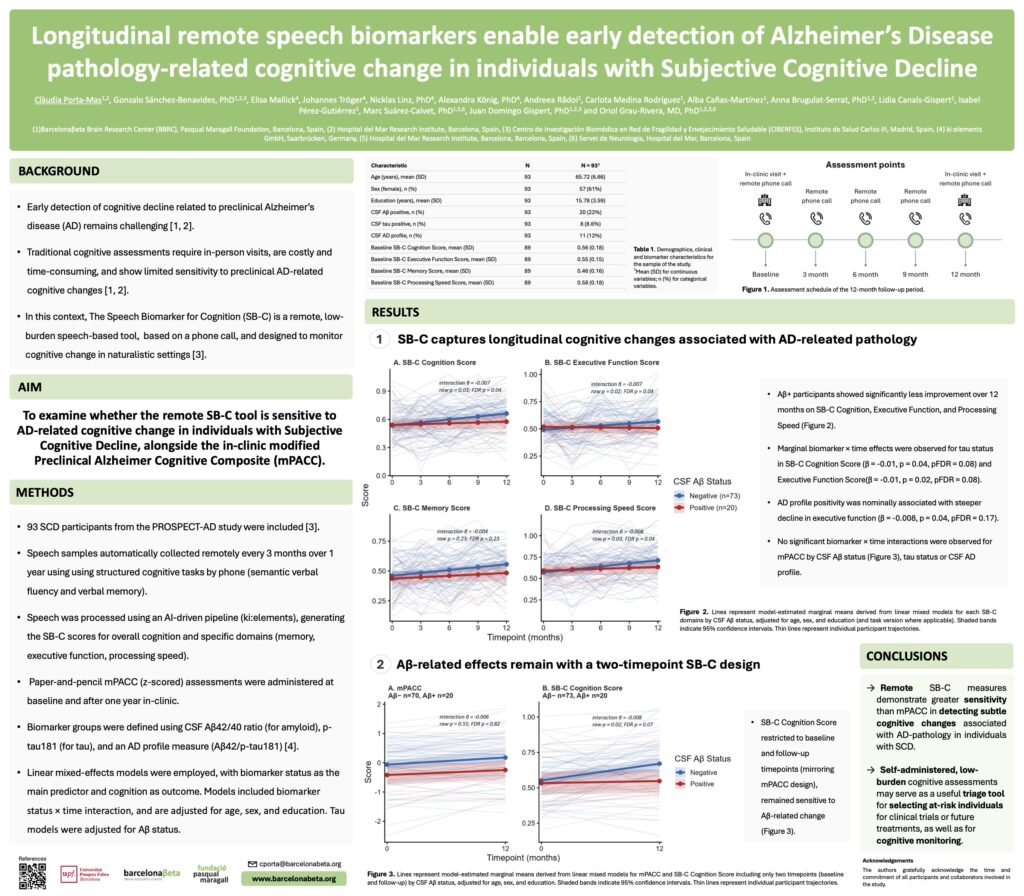
Methods: Participants include 93 participants with SCD, all with amyloid and tau characterization by cerebrospinal fluid (CSF) (Table 1). SB-C recordings were collected remotely every 3 months over one year using structured cognitive tasks (semantic verbal fluency and verbal memory). Speech was processed using a validated AI-driven pipeline developed by ki:elements, generating scores for overall cognition and specific domains (memory, executive function, processing speed). Paper-and-pencil PACC assessments were administered at baseline and at one year in-clinic. Biomarker groups were defined using CSF Aβ42/40 ratio (for amyloid), p-tau181 (for tau), and an AD profile measure (Aβ42/p-tau181). We employed linear mixed-effects models with biomarker status as the main predictor, including all timepoints available for SB-C and two timepoints for PACC as outcomes. Models included random intercepts and slopes for time, were adjusted for baseline age, sex, education and included time×biomarker interaction terms.
Results: Amyloid-positive participants showed significantly less improvement in SB-C scores for overall cognition (βSTD=-0.18,p=0.015; p_adj=0.029), executive function (βSTD=-0.18,p=0.014;p_adj=0.029), and processing speed (βSTD=-0.15,p=0.048; p_adj=0.064), with a trend toward reduced improvement in memory (βSTD=-0.15,p=0.065;p_adj=0.065) (Table 2; Figure 1). Tau-positive and AD profile-positive participants also showed similarly reduced improvement in SB-C executive function scores (Tau+: βSTD=-0.21,p=0.045;p_adj=0.045; AD-profile+: βSTD=-0.18,p=0.046;p_adj=0.046) (Table 2). In contrast, longitudinal changes in PACC scores did not differ by biomarker status (Aβ: βSTD=-0.04,p=0.57; tau: β=0.00,p=0.99; AD profile: βSTD=-0.10,p=0.27). When restricting SB-C Cognition Score to two timepoints to match the PACC design, the Aβ effect remained significant (βSTD=-0.29,p=0.01;p_adj=0.03) (Table 3).
Conclusion: Remote SB-C measures demonstrate greater sensitivity than the PACC in detecting subtle cognitive changes associated with AD pathology in individuals with SCD. Self-administered cognitive assessments may serve as a useful triage tool for selecting individuals for clinical trials or future treatments.