Alexandra König, Elisa Malick, Johannes Tröger, Oriol Grau-Rivera, Andreea Radoi, Claudia Porta-Mas, Gonzalo Sánchez Benavides
*Presented at CTAD 2025
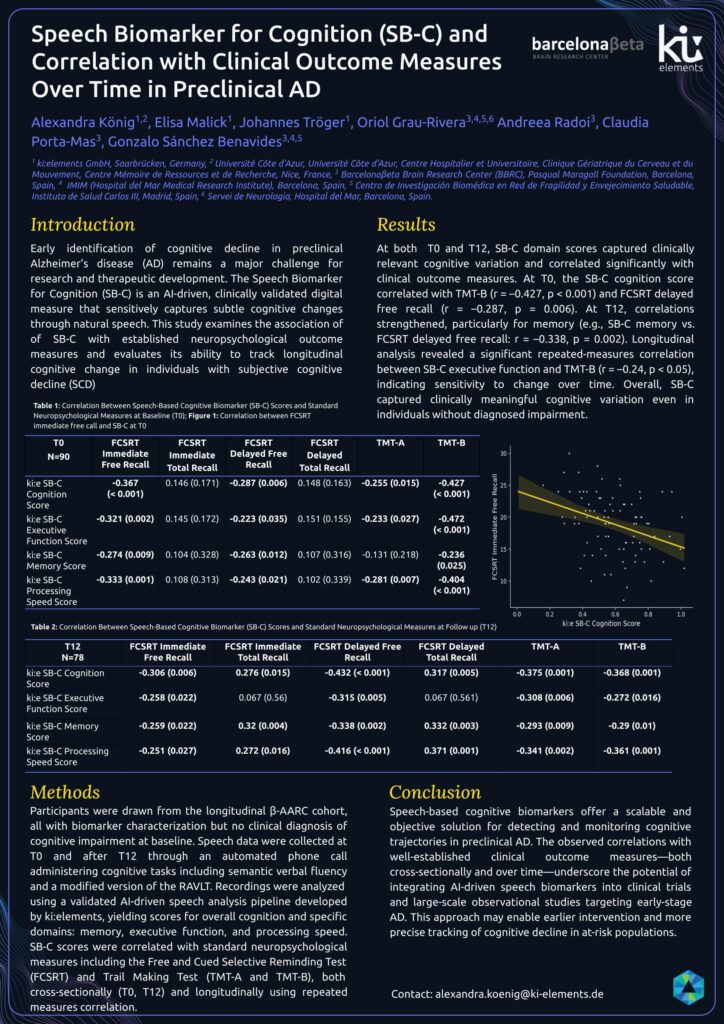
Introduction: Early identification of cognitive decline in preclinical Alzheimer’s disease (AD) remains a major challenge for research and therapeutic development. The Speech Biomarker for Cognition (SB-C) is an AI-driven, clinically validated digital measure that sensitively captures subtle cognitive changes through natural speech. This study examines the association of of SB-C with established neuropsychological outcome measures and evaluates its ability to track longitudinal cognitive change in individuals with subjective cognitive decline (SCD).
Methods: Participants were drawn from the longitudinal β-AARC cohort, all with biomarker characterization but no clinical diagnosis of cognitive impairment at baseline. Speech data were collected at T0 and after T12 through an automated phone call administering cognitive tasks including semantic verbal fluency and a modified version of the RAVLT. Recordings were analyzed using a validated AI-driven speech analysis pipeline developed by ki:elements, yielding scores for overall cognition and specific domains: memory, executive function, and processing speed. SB-C scores were correlated with standard neuropsychological measures including the Free and Cued Selective Reminding Test (FCSRT) and Trail Making Test (TMT-A and TMT-B), both cross-sectionally (T0, T12) and longitudinally using repeated measures correlation.
Results: At both T0 and T12, SB-C domain scores captured clinically relevant cognitive variation and correlated significantly with clinical outcome measures. At T0, the SB-C cognition score correlated with TMT-B (r = –0.427, p < 0.001) and FCSRT delayed free recall (r = –0.287, p = 0.006). At T12, correlations strengthened, particularly for memory (e.g., SB-C memory vs. FCSRT delayed free recall: r = –0.338, p = 0.002). Longitudinal analysis revealed a significant repeated-measures correlation between SB-C executive function and TMT-B (r = –0.24, p < 0.05), indicating sensitivity to change over time. Overall, SB-C captured clinically meaningful cognitive variation even in individuals without diagnosed impairment.
Conclusion: Speech-based cognitive biomarkers offer a scalable and objective solution for detecting and monitoring cognitive trajectories in preclinical AD. The observed correlations with well-established clinical outcome measures—both cross-sectionally and over time—underscore the potential of integrating AI-driven speech biomarkers into clinical trials and large-scale observational studies targeting early-stage AD. This approach may enable earlier intervention and more precise tracking of cognitive decline in at-risk populations.