Alexandra König, Janna Harrmann, Brett Veitch, Johannes Tröger, Nicklas Linz, Karen Blackmon, Mohamed Salama, Rashmin Gandhi, Sandra Cortés, Javiera Leniz, Irene B Meier, Vaibhav Narayan
*presented at AAIC 2025
Background: The rising prevalence of Alzheimer’s disease (AD) in Low- and Middle-Income Countries (LMICs) poses a significant public health challenge. Digital speech-based cognitive assessments offer scalable and cost-effective solutions for early detection and monitoring of cognitive impairment, a hallmark symptom of AD. However, their adoption and implementation face unique challenges in LMICs, including limited infrastructure, cultural and linguistic diversity, and varying levels of digital literacy. This presentation aims to outline these challenges and identify best practices for deploying digital speech-based cognitive assessments in LMICs.
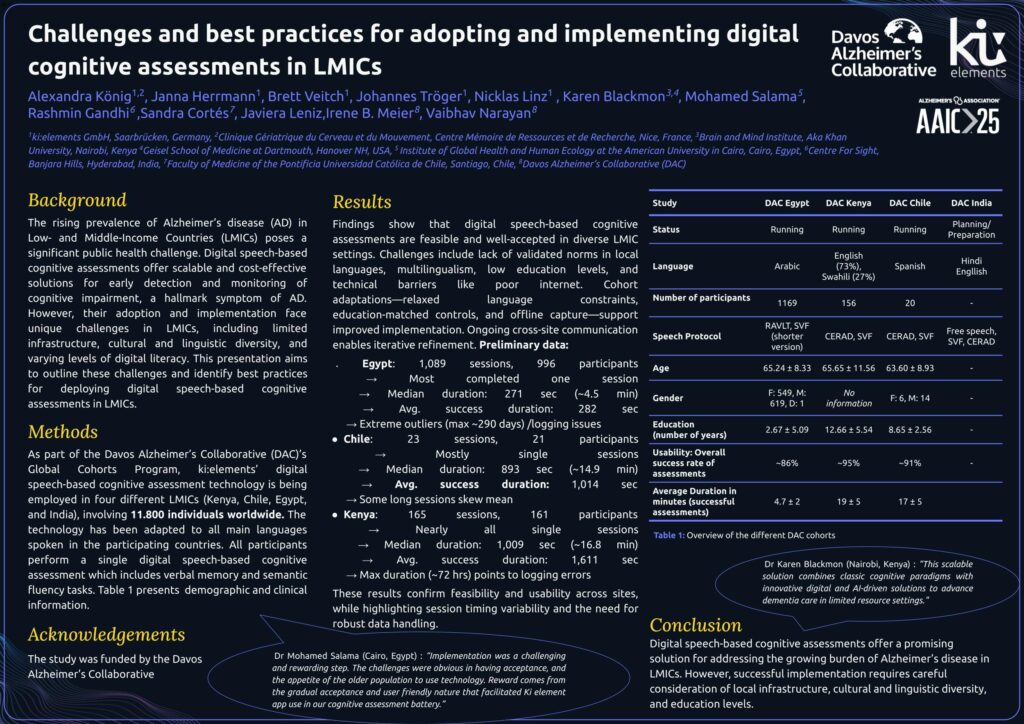
Methods: As part of the Davos Alzheimer’s Collaborative (DAC)’s Global Cohorts Program, ki:elements’ digital speech-based cognitive assessment technology is being employed in four different LMICs (Kenya, Chile, Egypt, and India), involving 11.800 individuals worldwide. The technology has been adapted to all main languages spoken in the participating countries. All participants perform a single digital speech-based cognitive assessment which includes verbal memory and semantic fluency tasks. Table 1 presents demographic and clinical information.
Results: Findings show that digital speech-based cognitive assessments are feasible and well-accepted in diverse LMIC settings. Challenges include lack of validated norms in local languages, multilingualism, low education levels, and technical barriers like internet. Cohort adaptations-relaxed language constraints, education-matched controls, and offline capture-support improved implementation. Ongoing cross-site communication enables iterative refinement.
Preliminary data: Egypt: 1,089 sessions, 996 participants
→Most completed one session Median duration: 271 sec (~4.5 min)
→Avg. Success duration: 282 Sec
→Extreme outliers (max ~290 days) /logging issues
• Chile: 23 sessions, 21 participants
→Mostly single sessions
→Median duration: 893 sec (~14.9 min)
→Avg. success duration: 1,014 sec
→ Some long sessions skew mean
• Kenya: 165 sessions, 161 participants
→Nearly all single sessions
→Median duration: 1,009 sec (~16.8 min)
→Avg. success duration: 1,611 sec
→ Max duration (~72 hrs) points to logging errors
These results confirm feasibility and usability across sites, while highlighting session timing variability and the need for robust data handling.
Conclusion: Digital speech-based cognitive assessments offer a promising solution for addressing the growing burden of Alzheimer’s disease in LMICs. However, successful implementation requires careful consideration of local infrastructure, cultural and linguistic diversity, and education levels.