Anahita Kyani, PhD; Federico Parisi, PhD; Dzmitry Kaliukhovich, PhD; Macarena Garcia Valdecasas Colell, PhD; Sara Gale, PhD, MPH; Charmaine Demanuele, PhD; Nicklas Linz, PhD; Johannes Tröger, PhD; Janna Herrmann, MS; Arthur Simen, MD, PhD; David Henley, MD; Fiona Elwood, PhD; Tricia Thornton-Wells, PhD; Lennert Steukers, DVM, PhD
Poster presented at AD/PD 2026
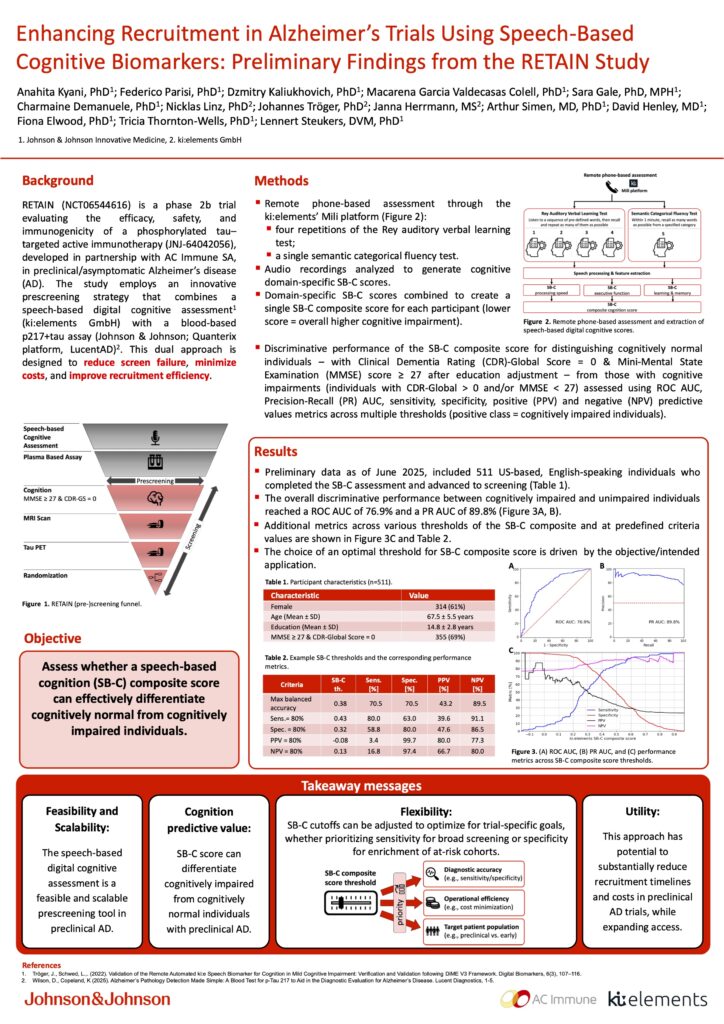
Background: RETAIN (NCT06544616) is a phase 2b trial evaluating the efficacy, safety, and immunogenicity of a phosphorylated tau–targeted active immunotherapy (JNJ‑64042056), developed in partnership with AC Immune SA, in preclinical/asymptomatic Alzheimer’s disease (AD). The study employs an innovative prescreening strategy that combines a speech‑based digital cognitive assessment1 (ki:elements GmbH) with a blood‑based p217+tau assay (Johnson & Johnson; Quanterix platform, LucentAD)2. This dual approach is designed to reduce screen failure, minimize costs, and improve recruitment efficiency.
Methods: Remote phone-based assessment through the ki:elements’ Mili platform (Figure 2): four repetitions of the Rey auditory verbal learning test;a single semantic categorical fluency test. Audio recordings analyzed to generate cognitive domain-specific SB-C scores. Domain-specific SB-C scores combined to create a single SB-C composite score for each participant (lower score = overall higher cognitive impairment). Discriminative performance of the SB‑C composite score for distinguishing cognitively normal individuals – with Clinical Dementia Rating (CDR)-Global Score = 0 & Mini-Mental State Examination (MMSE) score ≥ 27 after education adjustment – from those with cognitive impairments (individuals with CDR‑Global > 0 and/or MMSE < 27) assessed using ROC AUC, Precision-Recall (PR) AUC, sensitivity, specificity, positive (PPV) and negative (NPV) predictive values metrics across multiple thresholds (positive class = cognitively impaired individuals).
Results: Preliminary data as of June 2025, included 511 US-based, English-speaking individuals who completed the SB-C assessment and advanced to screening (Table 1). The overall discriminative performance between cognitively impaired and unimpaired individuals reached a ROC AUC of 76.9% and a PR AUC of 89.8% (Figure 3A, B). Additional metrics across various thresholds of the SB-C composite and at predefined criteria values are shown in Figure 3C and Table 2. The choice of an optimal threshold for SB-C composite score is driven by the objective/intended application.