Felix Menne, Felix Dörr, Johannes Tröger, Alexandra König, Diana Immel, Simon Barton, René Hurlemann
*Presented at SIRS 2026
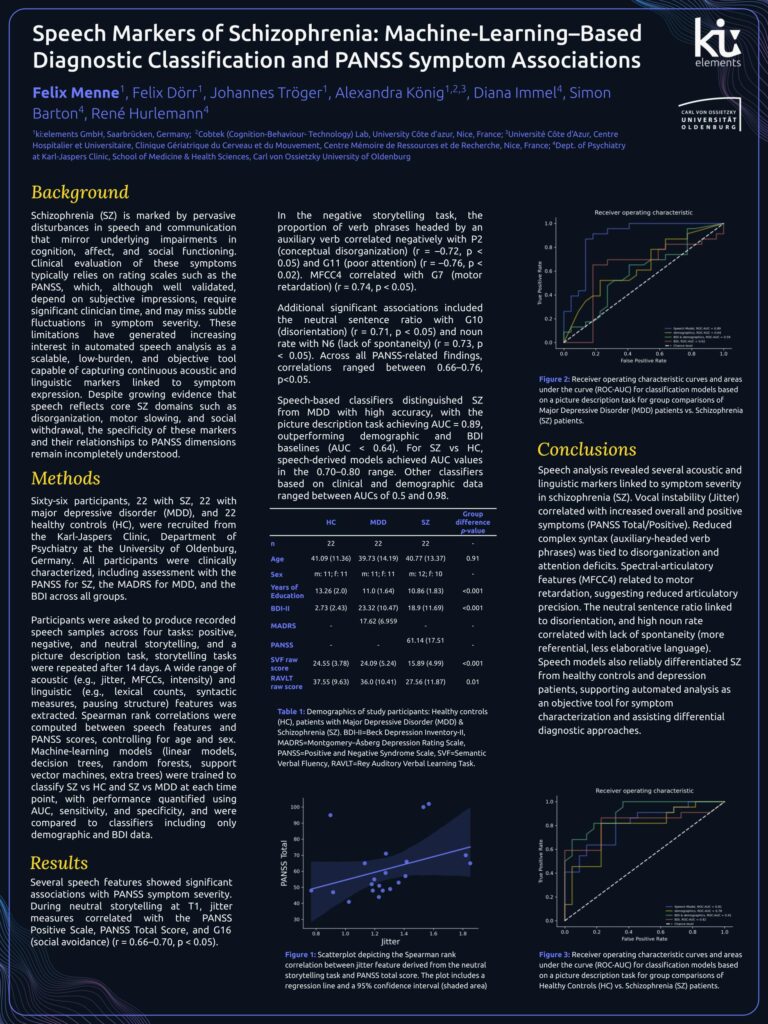
Background: Schizophrenia (SZ) is marked by pervasive disturbances in speech and communication that mirror underlying impairments in cognition, affect, and social functioning. Clinical evaluation of these symptoms typically relies on rating scales such as the PANSS, which, although well validated, depend on subjective impressions, require significant clinician time, and may miss subtle fluctuations in symptom severity. These limitations have generated increasing interest in automated speech analysis as a scalable, low-burden, and objective tool capable of capturing continuous acoustic and linguistic markers linked to symptom expression. Despite growing evidence that speech reflects core SZ domains such as disorganization, motor slowing, and social withdrawal, the specificity of these markers and their relationships to PANSS dimensions remain incompletely understood.
Methods: ixty-six participants, 22 with SZ, 22 with major depressive disorder (MDD), and 22 healthy controls (HC), were recruited from the Karl-Jaspers Clinic, Department of Psychiatry at the University of Oldenburg, Germany. All participants were clinically characterized, including assessment with the PANSS for SZ, the MADRS for MDD, and the BDI across all groups.
Participants were asked to produce recorded speech samples across four tasks: positive, negative, and neutral storytelling, and a picture description task, storytelling tasks were repeated after 14 days. A wide range of acoustic (e.g., jitter, MFCCs, intensity) and linguistic (e.g., lexical counts, syntactic measures, pausing structure) features was extracted. Spearman rank correlations were computed between speech features and PANSS scores, controlling for age and sex. Machine-learning models (linear models, decision trees, random forests, support vector machines, extra trees) were trained to classify SZ vs HC and SZ vs MDD at each time point, with performance quantified using AUC, sensitivity, and specificity, and were compared to classifiers including only demographic and BDI data.
Results: Several speech features showed significant associations with PANSS symptom severity. During neutral storytelling at T1, jitter measures correlated with the PANSS Positive Scale, PANSS Total Score, and G16 (social avoidance) (r = 0.66–0.70, p < 0.05).
In the negative storytelling task, the proportion of verb phrases headed by an auxiliary verb correlated negatively with P2 (conceptual disorganization) (r = –0.72, p < 0.05) and G11 (poor attention) (r = –0.76, p < 0.02). MFCC4 correlated with G7 (motor retardation) (r = 0.74, p < 0.05).
Additional significant associations included the neutral sentence ratio with G10 (disorientation) (r = 0.71, p < 0.05) and noun rate with N6 (lack of spontaneity) (r = 0.73, p < 0.05). Across all PANSS-related findings, correlations ranged between 0.66–0.76, p<0.05.
Speech-based classifiers distinguished SZ from MDD with high accuracy, with the picture description task achieving AUC = 0.89, outperforming demographic and BDI baselines (AUC < 0.64). For SZ vs HC, speech-derived models achieved AUC values in the 0.70–0.80 range. Other classifiers based on clinical and demographic data ranged between AUCs of 0.5 and 0.98.
Conclusion: Speech analysis revealed several acoustic and linguistic markers linked to symptom severity in schizophrenia (SZ). Vocal instability (Jitter) correlated with increased overall and positive symptoms (PANSS Total/Positive). Reduced complex syntax (auxiliary-headed verb phrases) was tied to disorganization and attention deficits. Spectral-articulatory features (MFCC4) related to motor retardation, suggesting reduced articulatory precision. The neutral sentence ratio linked to disorientation, and high noun rate correlated with lack of spontaneity (more referential, less elaborative language). Speech models also reliably differentiated SZ from healthy controls and depression patients, supporting automated analysis as an objective tool for symptom characterization and assisting differential diagnostic approaches.